Method · Flooring
Hard, chemical-resistant epoxy for indoor factories, showrooms and labs. We check the substrate first, then build the floor up layer by layer.
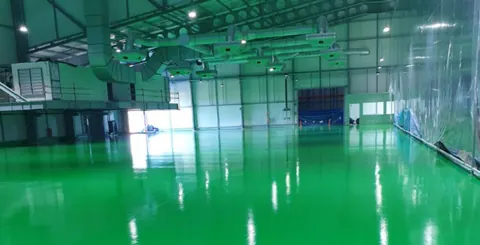
A two-part resin poured or rolled onto concrete. It cures into a hard, seamless, chemical-resistant floor that is easy to clean.
Indoor factories, showrooms and labs.
Layers (built up from the bottom)
A seamless floor finish that is easy to clean.
Soaks into the concrete so the next layer bonds.
Weak surface ground off, cracks and voids filled to a sound, flat base.
The figure shows one typical build-up. The actual layers are decided after we see the site.
Epoxy for general floors; thick PU cement screeds for food, cold storage and hot-wash areas.
Slab moisture is always measured before a resin floor; damp slabs need a moisture barrier or a moisture-tolerant system.
Floors are chosen by how they are used. If another floor fits better, we will say so.
| Floor | Strength | Where |
|---|---|---|
| Epoxythis page | Smooth seamless floor, easy to clean | Indoor factory, showroom, lab |
| Epoxy ESD | Drains static to earth through a grounded layer | Data center, electronics |
| Polyurethane (PU) Coating | Flexes; outdoors with a UV-stable top coat | Outdoor, moving substrates |
| PU Cement (PU + cement) | Thick & tough, survives sudden hot/cold + hot-wash | Food, cold storage, pharma |
| Polyurea | Sets in seconds, extremely tough | Extra-high durability areas |
| PMMA | Fast cure — the floor reopens the same day | Car park deck, floors that must reopen fast |
| STPE | Goes down on damp (not wet) slabs | Basin floors, enclosed damp areas, high-moisture slabs |
| FRP Lining (resin + glass fiber) | For severe chemicals, mainly strong acids | Treatment & chemical floors |
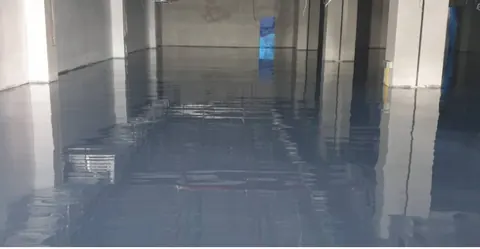
Also with this method:Lenzing (Thailand) – T3 Project · Thai Oil (OC3) · Metropolitan Electricity Authority, Huai Khwang District · Propylene Oxide (PO) Project · Stock Exchange of Thailand (SET), Bangkok · Ratchaprarop Hotel · Chao Pho Suea Shrine · Poultry Processing Plant · Mahachai Green Power · Atom Manufacturing · WD Megafoam · Envicco · Thai Koken
The floor area, the state of the substrate (whether cracks, chips or moisture need repair first), the type and build of the finish, the chemicals and traffic it must take, and the hours we can work. Send photos and drawings on LINE and we will check the site and quote.
Epoxy is hard and seamless — for general indoor floors. PU (polyurethane) flexes, and with a UV-stable top coat suits outdoor floors and substrates that move. PU cement is a thick, tough screed that survives sudden hot and cold (about –40 to +120 °C, by product) and hot-washing — for food, cold storage and pharma.
A damp slab needs a moisture barrier or a moisture-tolerant system. For high-moisture slabs and enclosed damp areas there is STPE, which goes onto damp (not wet) slabs, often with no primer. We measure the moisture before we choose.
Send the area, how the floor is used and a few photos. We check the site and propose the floor that fits.
Only want materials? psw-chemical.com ↗TEL +66 2 552 6468 · sales@passawarn.com