Method · Sheet membrane
For foundations, basement walls and slabs: a pre-applied HDPE sheet laid before the pour bonds to the concrete above it; a self-adhesive sheet goes onto finished walls with no flame.
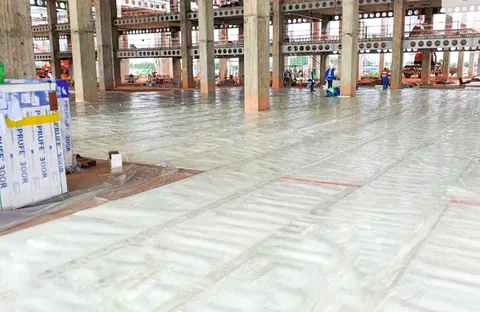
A high-density polyethylene sheet that is very stable against chemicals.
Below-ground waterproofing and containment of liquids in soil.
A below-ground and containment sheet rather than an exposed roof finish. Until the pour it is protected from sun, concrete splash and welding sparks.
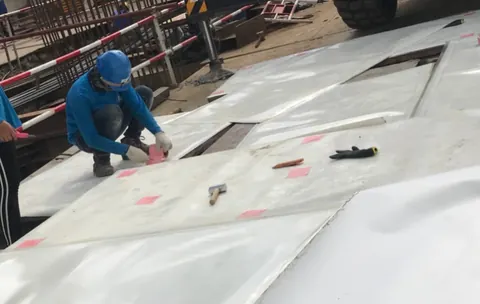
A peel-and-stick bitumen sheet, bonded without any flame.
Foundations and basement walls, and any site where hot work is not permitted.
On walls that will be backfilled, it is covered with a protection board first.
Layers (built up from the bottom)
The floor or wall concrete poured onto the membrane, bonding with it.
A tough sheet with a bonding layer that grips the concrete poured on top, leaving no gaps.
A thin, level layer over the ground on which the sheet is laid.
Shown: the pre-applied type, which bonds to the concrete poured on top of it.
The release paper is peeled off as the roll is laid, and it is rolled down hard; laps stick to each other.
For systems that need a primer: rolled or brushed on, and left until it is no longer tacky.
Smooth, clean concrete with sharp projections removed.
The figure shows one typical build-up. The actual layers are decided after we see the site.
We inspect the substrate — moisture, cracks, laitance — before choosing the system. A wrong substrate defeats any membrane.
No flame — for foundations and basement walls, then protected before backfill.
Sheets are chosen by where they go — roof, below ground or containment. If another one fits better, we will say so.
| Sheet | Strength | Where |
|---|---|---|
| APP (Torch-on) | Copes with heat & sun better than SBS — common in hot climates | Roof, deck |
| Self-Adhesivethis page | Easy install, no torch | Foundation, basement wall |
| SBS | Cold-flexible | For cold climates |
| PVC | Widely used on large roofs, easy to install | Roof |
| TPO | Chlorine- and plasticiser-free, recyclable where taken back | Roof |
| HDPEthis page | Resists most acids, alkalis and salts — below ground / containment | Below ground, containment |
| ECB | Cold-flexible, below ground | Below ground |
| EPDM | Rubber with excellent heat, UV & weather resistance; not for oil or solvents | Roof, below ground |
| Bentonite / GCL | Clay sheet, swells with water | Below ground |
Also with this method:Mochit Complex · HOT 1 · The Unique · TIPCO Building II · AMT-FB01 Battery Factory · GPSC
The area, the state of the substrate (cracks, wet spots, or an old membrane to remove), the system and number of layers, whether it is exposed to the sun, and the hours we can work. Send photos and drawings on LINE and we will check the site and quote.
A pre-applied HDPE sheet is laid before the concrete is poured and bonds to the concrete poured on top of it. A self-adhesive sheet is a peel-and-stick bituminous sheet put onto finished foundations and basement walls, with no flame, and covered with a protection board before backfilling.
No — these are sheets for below ground and containment, not an exposed-roof finish. For roofs see PVC / TPO sheets or liquid membranes.
Send the roof area, what is on it now and a few photos. We check the site and propose the sheet that fits.
Only want materials? psw-chemical.com ↗TEL +66 2 552 6468 · sales@passawarn.com