Method · Liquid-applied waterproofing
Liquid polyurethane cures into a rubbery, highly elastic membrane — for outdoor roofs and decks that move with the heat.
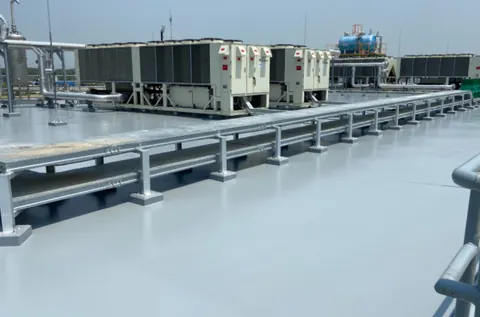
A liquid polyurethane membrane that cures into a rubbery, highly elastic film. Aliphatic grades are UV-stable, and many can be left exposed.
Outdoor roofs and decks that move with heat and need a seamless, flexible membrane.
Standard grades are protected by a UV top coat where exposed; many aliphatic grades need none (per the data sheet).
Layers (built up from the bottom)
Shields the membrane from sunlight, fading and wear.
Seamless membrane that stretches to follow cracks.
Soaks into the concrete so the membrane bonds firmly.
Clean, dry concrete, ready to receive the system.
The figure shows one typical build-up. The actual layers are decided after we see the site.
We inspect the substrate — moisture, cracks, laitance — before choosing the system. A wrong substrate defeats any membrane.
Primer → body coat (the working membrane, 1–2 coats) → top coat when UV or chemicals need it. Each layer waits its own cure time before the next.
Roofs and tanks get a water (ponding) test before handover; the result is signed off jointly.
Liquid membranes are chosen by where they go and the conditions on site. If another one fits better, we will say so.
| Membrane | Strength | Where |
|---|---|---|
| Acrylic (water-based) | Paint-like, cheapest | Roof, exterior wall |
| Bituminous Liquid | Liquid asphalt, low-cost, below ground | Below ground |
| Polyurethane (PU)this page | Flexible; Aliphatic grades are UV-stable | Outdoor — roof, deck |
| Polyurea — Pure / Hybrid | Sets in seconds; drinking-water tanks take a potable-certified grade | Water tanks |
| Silicone | Very UV-resistant; ideal over existing membranes | Over existing membranes (repair) |
| PMMA (Methyl Methacrylate) | Works through the rainy season, rain-resistant in about 30 minutes at 20 °C | Metal-sheet roof, deck, roof garden, joints |
| STPE | Goes onto damp (not wet) substrates | Basins & pits, enclosed damp areas, non-absorbent substrates |
Also with this method:Stock Exchange of Thailand (SET), Bangkok · PTT Global Chemical (IPG) · Angsana Laguna Phuket · Thai Beverage · Asakan Place Srinakarindra · Polyols (PY) Project · Talesun Technologies (Thailand) · Golf Course · New Concept · House of Mekhong · Wat Pacittabhavana · Nestlé LEO Factory, Rayong · Bangchak Refinery, Bangkok · AMT-FB01 Battery Factory · Royal Thai Air Force · PTT LNG Nong Fab LNG Receiving Terminal · Landmark Waterfront · Cosi Pattaya · The Forestias · Green Spot Head Quarter
The area, the state of the substrate (cracks, wet spots, or an old membrane to remove), the system and number of layers, whether it is exposed to the sun, and the hours we can work. Send photos and drawings on LINE and we will check the site and quote.
The standard grade is protected with a UV top coat where it is exposed. Aliphatic grades are UV-stable, and many need no top coat — we follow the data sheet for the grade chosen.
Substrate moisture is measured before we apply, and the system is chosen for damp or dry substrates accordingly. For basins, pits and enclosed damp areas there is STPE, which goes onto damp (not wet) substrates, often with no primer.
Send the area, the substrate and a few photos. We check the site and propose the membrane that fits.
Only want materials? psw-chemical.com ↗TEL +66 2 552 6468 · sales@passawarn.com