Method · Repair & strengthening
Polymer-modified repair mortar is filled by hand into chipped or spalled concrete — no formwork, about 30–50 mm per layer depending on the product (less overhead). We find the cause first.
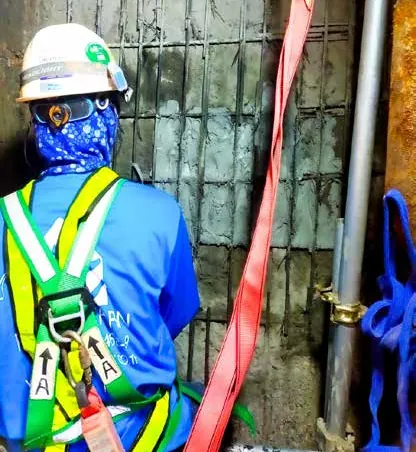
Polymer-modified repair mortar filled by hand into chipped or spalled concrete — no formwork, about 30–50 mm per layer depending on the product (less overhead).
Chipped or spalled surfaces on columns, beams, slabs and walls.
Large voids in columns, beams or machine bases are filled by grouting instead.
Layers (built up from the bottom)
Polymer-modified mortar filled by hand, with no formwork.
Where the product calls for it, brushed onto the damp (not wet) concrete first so the repair mortar bonds.
Loose and spalled concrete is removed and the surface cleaned.
The figure shows one typical build-up. The actual layers are decided after we see the site.
We find the cause — corrosion, movement, leakage or overload — and pick the method for it.
We find the cause first, then pick the method for it — not just "cover it up".
| Method | What it does | Symptom |
|---|---|---|
| Patching — Surface Repairthis page | Hand-fill chipped/spalled areas. No formwork; about 30–50 mm per layer by product (less overhead). Polymer-modified repair mortar. | Chipped / spalled surface |
| Grouting — Filling Voids | Pour or pump into large voids in columns, beams, machine bases (formwork / pressure). Non-shrink grout (no shrink when cured as directed, tight bond) ・ Epoxy grout (high strength, resists chemicals and vibration). | Large void in a column, beam or machine base |
| Crack Injection — Epoxy or PU resin | Epoxy resin restores strength in dry cracks ・ wetter cracks take flexible PU resin, which seals but does not restore strength. | Structural crack — restore strength |
| Crack Injection — Stop leaks: PU Foam | Foams on contact with water and stops it fast. | Crack that leaks water |
| Crack Injection — Stop leaks: Hydrogel | Swells into a soft, flexible gel — for leaks at joints that move a little. | Leak at a moving joint |
| CFRP Strengthening | Not repair — the goal is to increase the load a structure can carry (e.g. raise a floor's load capacity). 3 forms: Fabric/Wrap ・ Plate/Laminate ・ Rod/Bar. Requires structural-engineer design (ACI 440.2); damaged concrete is repaired first. | Need to carry more load |
Also with this method:Bangchak Refinery, Bangkok
The size and depth of the damaged areas, how many there are, and access (scaffolding, work overhead). Send photos of the damage on LINE.
Patching is filled by hand with no formwork, about 30–50 mm per layer depending on the product (less overhead). Deeper repairs are built up in layers; large voids in columns, beams or machine bases are filled by grouting instead.
No — we find the cause first (corrosion, movement, leakage or overload) and pick the method for it.
Send photos of the crack or damage and where it is. We diagnose the cause and propose the method.
Only want materials? psw-chemical.com ↗TEL +66 2 552 6468 · sales@passawarn.com